



Starting July 1, 2026, the economics of selling into Europe will change for nearly every ecommerce brand shipping internationally.
New customs duties, handling fees, and country-specific requirements will increase the landed cost of many low-value shipments. For brands operating across DTC, marketplaces, retail, and international channels, the impact extends far beyond customs compliance—it affects pricing, fulfillment strategy, customer experience, and profit margins.
Quick Summary: What’s Changing with EU Customs?
EU customs compliance will undergo a big shift affecting the cost of every cross-border shipment into Europe. In February 2026, the EU Council passed a legislative measure aimed to reform the duties collected on EU imported goods, called Council Regulation (EU) 2026/382.
The regulation aims to enhance compliance with fiscal and non-fiscal requirements by customs authorities and address the challenges posed by the increasing volume of low-value imports, particularly due to the growth of ecommerce.
The primary changes include:
- Elimination of the €150 IOSS duty-free threshold.
- A new flat-rate customs duty of €3 per item will be applied to low-value parcels entering the EU.
This will become effective July 1, 2026. The €3 interim rate runs until July 1, 2028, at which point standard Common Customs Tariff rates apply to all EU imports, in many cases at higher rates than the €3 interim duty.
- The duty may be extended. A mandatory assessment (per TAXUD guidance) will need to be made by the Commission by December 1, 2027 to determine whether the EU Customs Data Hub is operational.
Why This Matters for International Brands
The changes touch all international shippers. The average brand generates 10-20% of revenue internationally. The leaders reach 40-60%. The gap between average and leading brands is rarely demand, it is risk. Brands who risk compliance exposure, pricing that does not travel, and supply chains that aren’t built to flex across markets will be the ones tested by this EU reform.
What many brands may not realize is that this is an operational shift, not singularly a cost shift. The reform introduces a new incentive for brands to evaluate how products are grouped, labeled, and shipped. Because duties are tied to distinct HS classifications, packaging decisions can directly influence total customs costs.
This does not mean brands should alter classifications or compliance practices. It means fulfillment, trade compliance, and logistics teams must work together to understand how shipment composition affects landed costs. A brand (or 3PL on their behalf) who understands how to optimize pack configurations against that structure reduces landed cost exposure on every order.
Delivered Duty Unpaid (DDU) shipments will perform worse from July onward: surprise charges at the door mean rejected deliveries and lost repeat buyers. Accurate landed cost at checkout, combined with Delivered Duty Paid (DDP) delivery, keeps the customer experience clean through the transition.
For most brands, HS codes, landed cost calculations, checkout pricing, and fulfillment configurations sit across separate systems. A brand running manual HS classification, a static landed cost model, and a 3PL packing to operational efficiency rather than duty optimization has no clear view of what the reform costs per order, and no way to act on it before July 1.
Key Changes: EU Customs Changes Effective July 1, 2026
The key details:
- €3 per item, not per parcel. Per Article 222 of Commission Implementing Regulation (EU) 2015/2447, “item” means each distinct HS6 subheading in the shipment. Three HS6 codes in one parcel means €9 in duty. The new Article 1(61) UCC-DA (Delegated Act of 30 April 2026, pending official publication in the Official Journal) provides a parallel definition: one or more goods in a consignment sharing the same tariff classification, description and, where provided, origin.
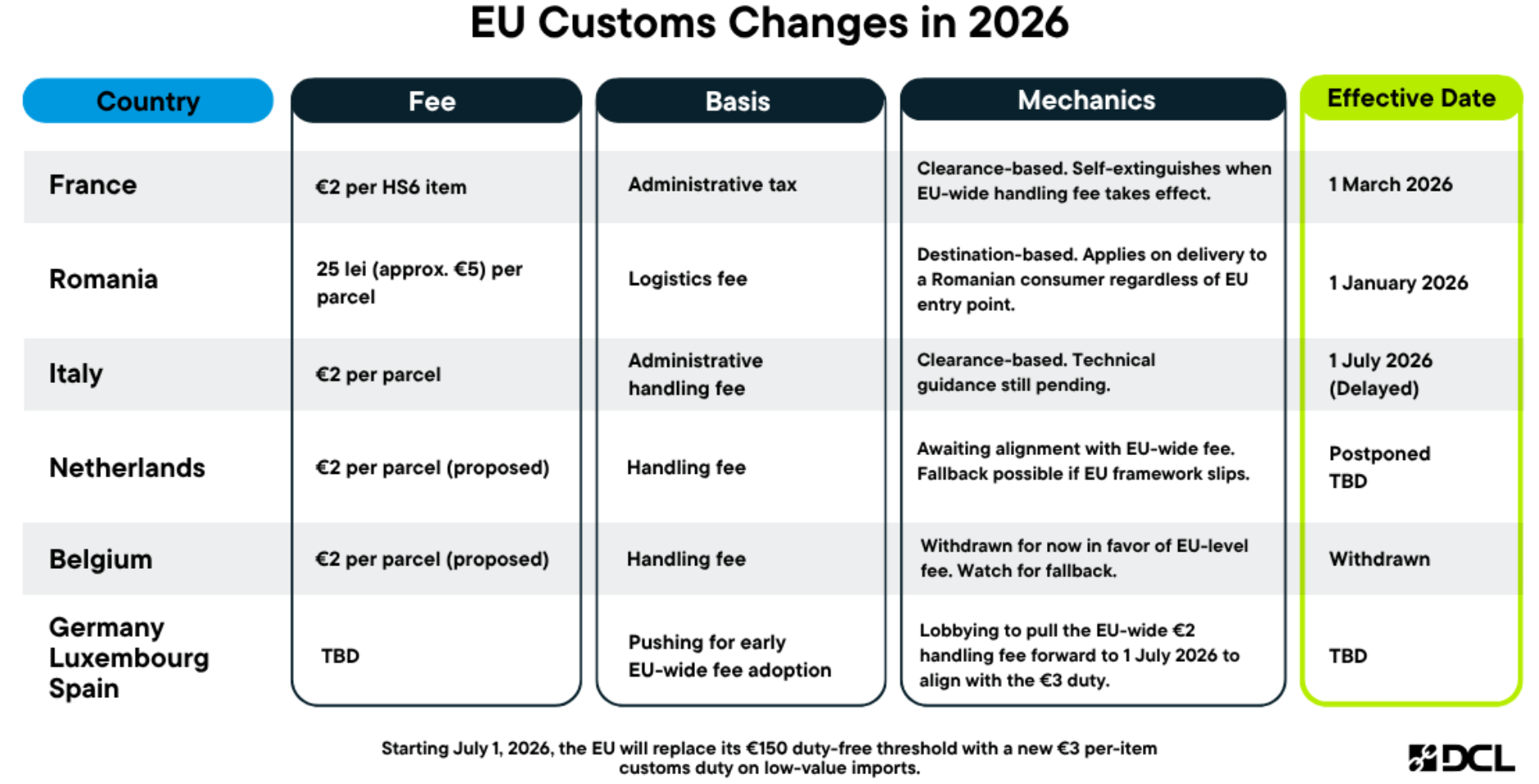
- Italy adds €2 per parcel. Delayed from an earlier date, Italy’s clearance-based handling fee now aligns with July 1.
- An EU-wide handling fee (~€2) is pending. Targeted for November 1, 2026, but the amount and basis (per parcel or per HS6) are still subject to a delegated act. EU timelines at this scale regularly slip.
Two EU member states introduced national administrative handling fees ahead of the EU-wide framework. Unlike the €3 customs duty (which is an exclusive EU competence under Article 3 TFEU and directly applicable across all member states), these are member-state-level administrative fees.
- France (effective March 1, 2026): €2 per HS6 subheading, clearance-based, applying to sub-€150 shipments. France’s fee is legally designed to self-extinguish once the EU-wide handling fee takes effect in November.
- Romania (effective January 1, 2026): €5 per parcel, destination-based, applying to sub-€150 shipments. Romania’s fee does not appear to contain the same self-extinguishing mechanism as France’s; it is not tied to the Union handling fee and may continue to run concurrently after November (to be confirmed).
All EU shipments also carry import VAT at the destination country rate (20% in France, 21% in the Netherlands, 23% in Portugal). Under IOSS, VAT is collected at checkout and remitted centrally. While IOSS simplifies VAT collection by allowing merchants to collect tax at checkout and remit centrally, it does not reduce the overall tax burden. Brands operating under DDP models must still account for VAT in their pricing strategy, margin calculations, and landed cost forecasts.
A $100 apparel order with three different HS6 codes shipping to a French consumer will carry roughly €15 in added duties and fees by July 1, up from zero before March. That is a 15 to 17 percent increase on the order value.
Fee Status by Country
Marketplace Impact: Review Customs for All Channels
Brands selling through marketplaces into the EU should not assume these changes are automatically absorbed by the platform. Depending on the sales model, fulfillment method, and importer of record structure, the new duties and fees can still affect pricing, profitability, and customer experience.
Brands should review how customs costs are being handled across each sales channel and ensure their landed cost calculations remain accurate.
Returns: €3 Duty Is Not Automatically Refunded
Once the €3 duty has been paid, it cannot be automatically reclaimed if the consumer returns the goods. Under the new amended Article 148(3) UCC-DA, economic operators may no longer request the invalidation of the customs declaration for release for free circulation of goods sold in distance sales and in a consignment of an intrinsic value not exceeding EUR 150, where these goods are returned after their release. General EU customs repayment rules still technically apply, but the administrative process is disproportionate relative to a €3 charge. Returns should now be factored into your landed cost model as a duty loss.
Five Actions Brands Should Take Before July 1For most brands currently selling into Europe, completing these steps means touching three separate systems. Get them connected before July 1.
- Audit your HS classification. Every distinct HS6 code in a parcel adds €3 to the EU duty bill from July 1. Inaccurate codes inflate costs and create compliance exposure.
- Update your EU landed cost model. France and Romania fees are live now. The €3 EU duty and Italy’s €2 fee land July 1. A static model is already wrong.
- Move to DDP. DDU delivery into the EU will produce materially worse customer outcomes from July. DDP with accurate landed cost at checkout is the right setup.
- Review Fulfillment and Shipment Configuration. Evaluate how products are grouped and shipped into EU markets, as fulfillment decisions can directly impact landed costs when multiple HS classifications are included in a shipment.
- Stress-Test International Margins. Model the impact of the new duties, VAT obligations, handling fees, and expected return rates by market. Brands may need to adjust pricing, promotions, or channel strategies to maintain profitability.
Why Europe is Making These Changes
The reform is part of a broader global trend toward tighter cross-border enforcement and increased scrutiny of ecommerce imports.
Governments worldwide are reevaluating de minimis thresholds, customs collection processes, and marketplace accountability as international ecommerce volumes continue to grow. Europe’s move follows similar discussions in the United States, Canada, and other major import markets.
Technology and Automation Matter More Than Ever
The challenge for many brands is that customs data, product information, pricing, checkout experiences, fulfillment operations, and shipping workflows often live in separate systems. As regulations become more complex, manual processes become increasingly difficult to scale. Automated landed-cost calculations, centralized HS classification management, and real-time compliance monitoring will become critical components of international growth strategies.
Intelligent cross-border platforms will be a benefit to brands who have them implemented or work with international partners who have them. When one country fee changes, when compliance aspects change (HS classification, landed cost calculation, customs brokerage, and DDP delivery) you will see it live in real-time before any deadline. As additional EU measures come online, an automated platform will absorb these changes automatically.
Bottom Line: Cross-Border Compliance Is Becoming a Competitive Advantage
The July 1 reform should not be viewed as a temporary customs change. It reflects a broader shift in how governments regulate cross-border ecommerce.
Supply chain partners need to work in tandem to support brands through these changes. Everything from fulfillment and packaging to cross-border compliance are all contributing factors. Brands need visibility through their entire supply chain stack to ensure all components are considered, across all counties served. When a fee changes in one aspect, you need automated systems that will react quickly so that you’re not left without knowing if you’re compliant or not.
Success will depend on having accurate product data, automated landed cost calculations, strong fulfillment execution, and the visibility needed to respond quickly as regulations continue to evolve. Brands need the domestic fulfillment precision and cross-border compliance infrastructure to keep international revenue growing and prevent margin from eroding. In a world where international commerce is becoming more complex, operational agility may become the most valuable competitive advantage of all.
Rathna Sharad is the CEO and Founder of FlavorCloud, the AI-native cross-border commerce OS helping brands grow internationally with guaranteed DDP delivery, automated customs compliance, and supply chain orchestration across 200+ countries.
Tags: Expert Advice & Tips, International